
Event recap: insideMOBILITY® New York City | May 5-6, 2026
Gaining a different view on talent mobility
insideMOBILITY® New York City explored the many ways in which talent mobility is evolving beyond relocation – prompting the idea of a rebrand into a more strategic, technology-supported role. Think: global mobility to talent movement.
To step higher into this concept and learn more about the conversations had, check out the interactive recap.

Executive Summary
Global mobility is no longer viewed as focused solely on moving employees from point A to point B. Instead, it’s becoming a strategic lever tied directly to workforce planning, leadership development, retention, and business growth. The case could be made this shift is driving an industry rebrand that better reflects global mobility’s broader role in enabling talent strategy, organizational agility, and long-term business outcomes.
Step higher into the four factors changing the view on the industry—and how they showed up in insideMOBILITY® New York City discussions. Explore event insights alongside complementary perspectives, expert viewpoints, and practical resources that bring additional context to the trends shaping what comes next.
- 1. Employee Expectations Have Fundamentally Changed
- 2. Talent Strategy and Workforce Planning Are Becoming More Connected to Mobility
- 3. AI and Digital Transformation Are Redefining Service Expectations
- 4. Global Complexity and Risk Are Elevating Mobility Into a Governance Function
Employees today expect more than a relocation package. They want flexibility, personalization, and support that aligns with their careers, families, and long-term goals. For mobility leaders, this shift presents both an opportunity and a challenge: how do you provide greater choice without creating confusion, inconsistent outcomes, or increased costs?
Live from New York City:
Attendees at insideMOBILITY® explored how changing employee expectations are reshaping the future of mobility. A recurring theme emerged: the organizations creating the best employee experiences aren’t necessarily offering more benefits — they’re helping employees make better decisions.
As organizations compete for talent and rethink how work gets done, the purpose of mobility is expanding. Increasingly, mobility is being viewed as a workforce capability that can help organizations deploy skills, develop leaders, and build greater organizational agility. But the transition from global mobility to talent movement is not happening automatically.
Live from New York City:
Discussions at insideMOBILITY® highlighted a critical challenge: while the industry is evolving, many organizations still engage mobility too late in the decision-making process and continue to measure success through a relocation lens. The result is a missed opportunity to leverage mobility as a strategic driver of talent and business outcomes.
AI is rapidly transforming how organizations manage workforce movement, employee support, and operational efficiency. Yet while some mobility teams are embedding AI into daily workflows, others are still determining where to start. As the industry evolves from global mobility to talent movement, AI is becoming a key differentiator — is your team falling behind on AI?
Live from New York City:
Conversations at insideMOBILITY® revealed that AI adoption is no longer a question of if, but how. Attendees discussed emerging use cases, implementation challenges, and the skills mobility professionals will need as the function continues to evolve.
The world of talent movement is becoming increasingly complex and the consequences of being unprepared can be significant. Yet many organizations still rely on processes and governance models that were designed for a simpler mobility landscape. Is your organization ready for the next crisis?
Live from New York City:
During two mock crisis exercises at insideMOBILITY®, attendees were challenged to navigate realistic workforce disruption scenarios. The exercises revealed common gaps in preparedness, decision-making, communication, and cross-functional coordination.
1. Employee Expectations Have Fundamentally Changed
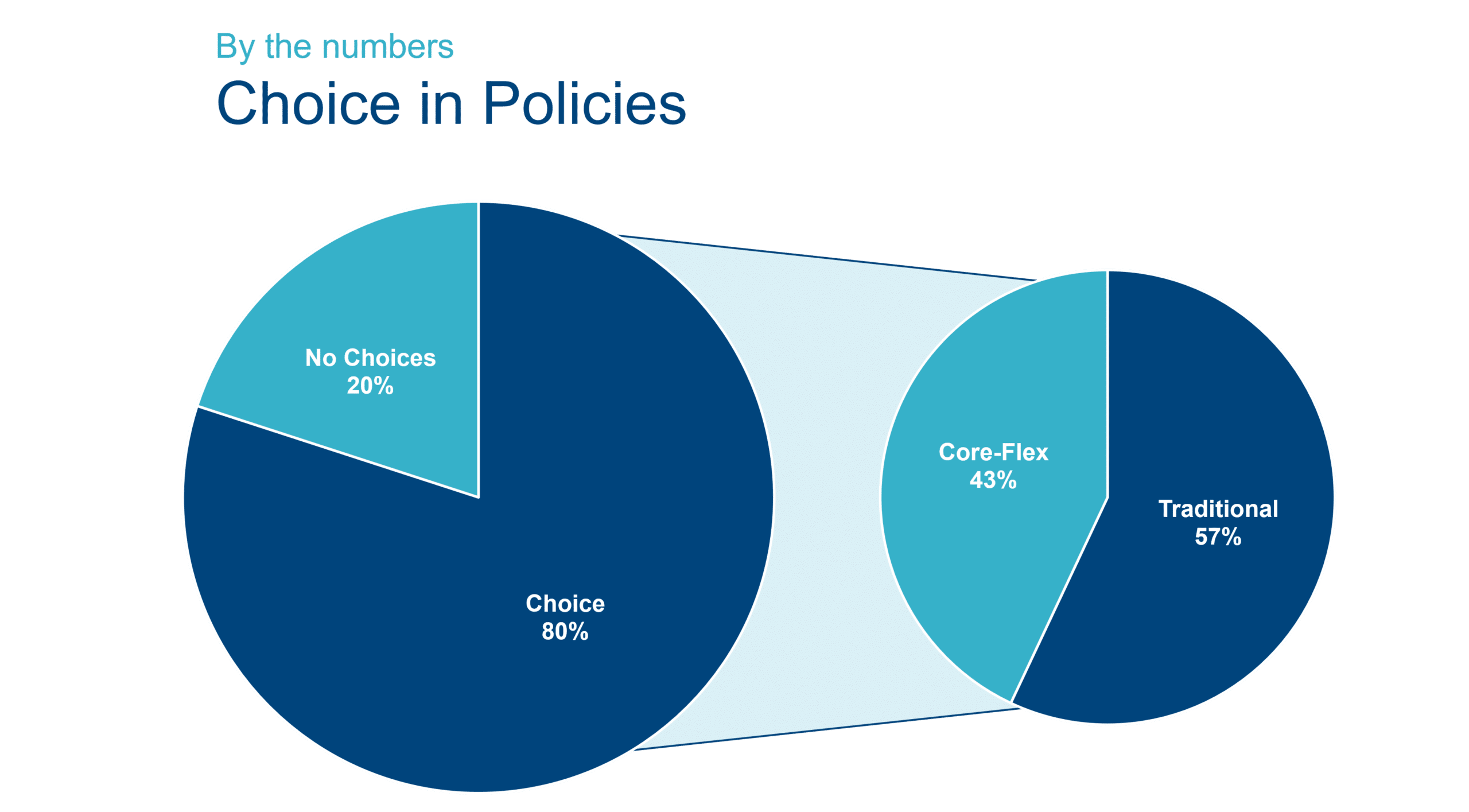
Hybrid work, flexibility, personalization, and changing lifestyle priorities have altered what employees expect from mobility and HR programs. Traditional one-size-fits-all policies built for pre-pandemic workforces no longer align with today’s talent realities and there’s a shift toward tailored experiences, segmented policies, flexible benefits, and support models that recognize different employee needs, move types, and career stages.
Employee expectations are helping drive the rebrand from global mobility to talent movement. As workers seek greater flexibility, personalization, and career support, mobility programs are increasingly focused on helping employees navigate career opportunities, life transitions and workforce decisions with confidence.
Live from New York City
As employee expectations evolve, so must mobility programs. The focus is no longer on just balancing flexibility and cost, but on helping employees navigate their options with confidence. This creates an opportunity for mobility teams to evolve from relocation administrators into talent advisors who support both employee success and business goals.
Insights to Action
As mobility programs become more flexible, success depends not only on offering choices but on helping employees understand how to make the right choices for their unique circumstances. You can help your mobility team strengthen employee outcomes by:
- Clearly explaining the tradeoffs associated with different benefit options, including when a cash allowance may provide flexibility but deliver less overall value than managed services.
- Providing self-service tools and curated resources that help employees evaluate their options based on family needs, timelines, budgets, and relocation complexity.
- Offering trusted guidance to help employees avoid costly mistakes, fraudulent providers, or unnecessary relocation expenses.
- Using employee feedback and program data to understand why certain benefits are selected and identify opportunities to improve program design.
- Maintaining a human connection throughout the process, ensuring employees feel supported even when they are given greater autonomy and flexibility.
In an increasingly personalized mobility landscape, the goal isn’t simply to provide more choice, it’s to help employees make confident decisions that support their careers, families, and long-term success. As global mobility evolves into talent movement, organizations that combine flexible programs, digital tools, data insights, and human guidance will be best positioned to deliver meaningful employee experiences while advancing broader talent and workforce goals.
2. Talent Strategy and Workforce Planning Are Becoming More Connected to Mobility
Talent movement is emerging as a critical workforce strategy. As organizations compete for specialized talent, address skills gaps and rethink where work happens, the traditional role of global mobility can expand beyond relocation support to a tool for leadership development, talent deployment, workforce agility, and career growth. Yet despite this evolution, many companies continue to view mobility through a relocation lens — creating a gap between the function’s growing strategic value and how it is perceived, engaged, and measured today.
Live from New York City
Discussions at insideMOBILITY® revealed a common challenge: while the industry is evolving from global mobility to talent movement, organizational perceptions have not always kept pace. Many companies still engage mobility as a downstream execution function rather than an upstream strategic partner capable of influencing workforce, talent, and business outcomes. Looking further:
Reduced influence on workforce decisions
Because mobility is still frequently viewed as a function to move employees from point A to B, it is often engaged after key decisions have already been made, limiting its ability to shape workforce planning, talent deployment, and organizational capability.
Cost dominates decision-making
Mobility is frequently measured through the lens of relocation costs, rather than talent outcomes, creating reluctance to deploy mobility strategically and leading to decisions driven by short-term expense rather than long-term workforce value.
Programs are not fit for the current workforce
Many programs were designed for a relocation-focused model that no longer reflects how organizations develop, deploy, and retain talent today, making it difficult to support evolving employee expectations and new forms of workforce movement.
Insights to Action
To accelerate the transition from global mobility to talent movement, leaders should focus on demonstrating how the function contributes to workforce capability, business growth, and talent outcomes by:
- Repositioning mobility as a talent strategy function Shift conversations away from moves and transactions and toward workforce agility, skills deployment, leadership development, talent acquisition, and retention.
- Building stronger executive understanding of talent movement’s business impact Regularly communicate how mobility supports critical business priorities, including filling skills gaps, developing future leaders, supporting organizational growth, and enabling workforce flexibility.
- Measuring outcomes, not just activity Expand success metrics beyond move volume and cost to include talent retention, speed-to-productivity, employee experience, leadership development, critical role fulfillment, and workforce agility.
- Modernizing programs for today’s workforce Redesign policies and support models to accommodate diverse career paths, hybrid work environments, evolving assignment types, and increasing employee expectations for flexibility and personalization.
- Leveraging workforce movement data as a strategic asset Use mobility insights to inform succession planning, skills deployment, talent availability, location strategy, and broader workforce planning decisions.
As organizations focus on building more agile, skills-based workforces, the most successful teams will be those that move beyond relocation management and position themselves as strategic partners in how talent is developed, deployed, and retained across the organization.
Sharpen Your Focus
Following his panel discussion at insideMOBILITY, workplace strategist Phil Kirschner expanded on these themes in his article, The Relocation Vocation. Discover why mobility’s future may be defined as much by talent strategy as by relocation.
3. AI and Digital Transformation Are Redefining Service Expectations
AI and automation are accelerating the evolution from global mobility to talent movement. Companies are increasingly using AI for workflow automation, research synthesis, employee support, analytics, and administrative efficiency, raising expectations around speed, personalization, and scalability. More importantly, AI is helping mobility teams spend less time on transactional tasks and more time on strategic work—supporting workforce planning, talent deployment, employee experience, and business agility.
As routine activities become increasingly automated, mobility professionals have an opportunity to focus on the bigger picture: how talent movement supports broader business goals.The rapid adoption of AI and automation is reshaping how mobility services are delivered and perceived. Companies are increasingly using AI for workflow automation, research synthesis, employee support, analytics, and administrative efficiency, which is changing expectations around speed, personalization, and scalability.
It’s also shifting mobility’s role from transactional administration and toward higher-value strategic advisory roles within HR and workforce planning, allowing teams to focus on the bigger picture: how talent movement supports broader business goals.
Live from New York City
Attendees consistently described AI as a tool that can help mobility teams operate more strategically by automating routine work, improving access to information, and creating more capacity for high-value talent and workforce initiatives. Three themes emerged:
Data governance is crucial
Employees using AI must ensure they’re taking steps to protect private information. This means not inputting personal or confidential information into tools, especially if you’re using general (non-work) accounts. When in doubt, check with company leadership about AI expectations and usage.
AI requires a mindset shift
Team leaders that can cultivate a mindset shift around AI in their teams will find the most success. Leaders should focus on helping people understand that AI can help increase productivity and efficiency – freeing employees up from the mundane tasks they least enjoy.
AI isn’t hard
There are quick, practical ways to incorporate AI into daily workflows. By automating routine administrative tasks, mobility and HR teams can dedicate more time to strategic initiatives that improve employee experiences, support talent decisions, and advance business objectives.
Where are you on the AI journey?
Cast your vote, then review how event attendees responded to compare your adoption with the collective outcome.
Insights to Action
As mobility evolves into talent movement, AI can help teams shift their focus from administration to strategy by accelerating work across key capability areas:
Communication
Applications include: Drafting, summarizing, coordinating, and documenting work
Analysis
Applications include: Surfacing trends, insights, and key takeaways from data and content
Content
Applications include: Developing policies, guidance, FAQs, and first-pass narratives
Personalization
Applications include: Tailoring outputs for specific audiences, roles, and business needs
Sharpen Your Focus
Start or evolve your AI literacy journey with the AI in Mobility Field Guide. A brief toolkit of ways to implement, expert advice, and tips for putting AI into practice today.
AI is not redefining mobility on its own—it is accelerating a transformation that is already underway. As the industry evolves from global mobility to talent movement, the most successful teams will use AI to automate routine tasks, surface insights faster, and create more time for strategic work.
The opportunities are practical, immediate, and increasingly accessible to teams of all sizes.
The future role of mobility professionals will be less about managing transactions and more about enabling workforce agility, supporting employee growth, and helping organizations deploy talent where it can have the greatest impact.
4. Global Complexity and Risk Are Elevating Mobility Into a Governance Function
Geopolitical instability, immigration challenges, compliance demands, climate-related disruptions, and heightened duty-of-care expectations are making global mobility significantly more complex. This calls for governance frameworks, scenario planning, cross-functional coordination, and structured prioritization and is pushing mobility teams to evolve into cross-functional strategic risk-management and business-continuity partners that help organizations navigate uncertainty while protecting employees and maintaining compliance.
Live from New York City
Attendees participated in two mock scenarios to highlight the increasingly complex and risk-prone world of talent movement.
Complexity Scenario: Mission to the Moon
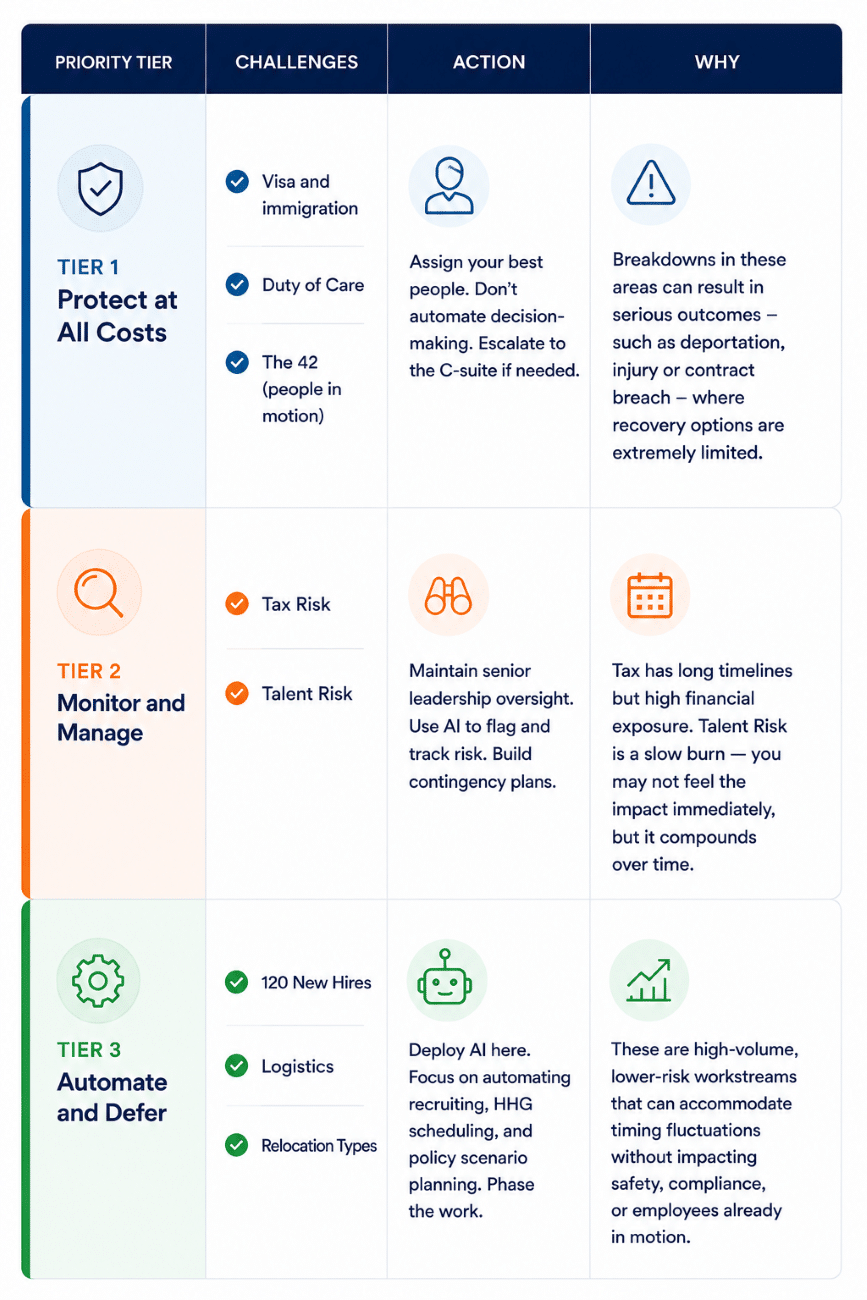
Overview: Participants broke into teams to solve the challenge of a multinational company deploying 42 specialist employees from around the world (with five distinct relocation types), hiring and training 120 local workers, and launching operations in a remote international location within 90 days, to help get a robotics assembly line for space exploration equipment up and running.
Challenge: Each team had to assess the same eight challenges and map them by importance and exposure, choose where to deploy AI, and decide where to spend their single executive approval token. The challenges were:
- People requirement – specialist employees
- People requirement – new hires
- Visa and immigration
- Tax risk
- Duty of care
- Talent risk
- Relocation types
- Logistics
What Emerged
While teams approached the scenario from different perspectives, a clear pattern emerged in how they assessed risk and allocated attention. Participants consistently distinguished between challenges that require human judgment and executive oversight and those that can be effectively supported through automation and process design.
Working through competing priorities, teams were forced to balance employee safety, compliance, operational readiness, and resource constraints. The exercise reinforced that effective mobility decision-making is not about treating every challenge equally, but understanding where intervention matters most and where technology can create capacity without increasing risk.

Risk Scenario: Tensions in the Middle East
Overview: Tensions in the Middle East are disrupting travel, transport, and supply chains, impacting corporate operations, mobility programs, and most importantly, employee safety. Often with limited warning, crises of this nature escalate quickly and create complex decision-making environments for global employers.
Challenge: Operating through the lens of distinct functional roles – CEO, CFO, general counsel, HR, risk, security, corporate communications, and global mobility – participants practiced role-based decision-making under uncertainty, each with distinct focuses:
- Executive leadership (CEO, CFO): Escalation decisions, resource allocation, and financial exposure
- Legal and risk functions: Compliance obligations, liability, and duty of care
- HR: Employee welfare, support, and workforce continuity
- Security and risk teams: Threats, monitored escalation triggers, and guided protective actions
- Corporate communications: Alignment of internal and external messaging
- Global mobility and travel: Employee tracking, travel restrictions, and repatriation logistics
What Emerged
The simulation created a structured, low-risk environment for attendees to apply crisis response principles, focusing on real-time decision-making, communication, and coordination across a broad set of stakeholders during a rapidly escalating security event.
Working across a variety of perspectives, participants were required to balance speed, risk, compliance, and employee safety — reinforcing that crisis response is not a single-function responsibility, but a coordinated enterprise effort.
Insights to Action
As talent movement becomes more strategic and complex effective risk management requires coordination across HR, legal, security, tax, immigration, communications, and business leadership. Here’s a checklist to bring back to your organizations to ensure you’re equipped to handle the next crisis.




As talent movement becomes more critical to workforce strategy, governance becomes a competitive advantage. Organizations that establish clear roles, decision-making frameworks, and communication protocols are better positioned to protect employees, maintain compliance, and respond confidently to disruption. In an increasingly complex environment, the ability to move talent safely, effectively, and responsibly may become one of the most important capabilities an organization can build.
Sharpen Your Focus
Featured speaker Julia Hobsbawm brought a thought-provoking perspective on the future of work to insideMOBILITY. In her article, The War for New Talent Mobility, she explores why talent movement is becoming a strategic imperative for organizations—and why, at the heart of it all, are people.
Where do we go from here?
As the world of work continues to evolve, talent mobility is entering a new era, one defined not only by relocation, but by workforce agility, employee experience, strategic planning, and business resilience. Mobility is no longer isolated from a broader corporate strategy — it’s becoming deeply integrated with decisions about where people work, where businesses grow, and how organizations compete for talent. Mobility is driving companies’ abilities to get the right people in the right place at the right time to get work done.
Yet even as the function expands into talent movement, its foundation in global mobility remains essential. The insights shared at insideMOBILITY® New York City underscored how the expertise built through decades of managing complex moves, supporting employees through major life transitions, and navigating compliance across borders is what enables mobility teams to take on a broader strategic role today.
The future of talent movement will belong to organizations that can blend that operational excellence with innovation, flexibility, and strategic partnership, transforming mobility from a service function into a critical driver of how companies attract, develop, and deploy talent in a rapidly changing world. Stay connected with Graebel events to continue learning and evolving on this new era for talent management.