Graebel and Reside Unite to Simplify How Organizations Deploy and Support Talent
Read Article


Note: This blog was updated with new information and insights on August 20, 2024. It was originally published on April 16, 2024.
Exploring the impacts, implications and possible solutions to changing compensation models for real estate professionals.
This is Part II of a two-part blog series about U.S. real estate trends. Part I focuses on general market trends, impacts to mobility programs and possible policy adjustment solutions – check it out here.
Amid calls for greater transparency and concern about high U.S. housing transaction costs, the way mobile employees and mobility managers work with real estate agents is changing. Since many U.S. real estate professionals are members of the National Association of Realtors® (NAR), agents and brokers were bound until recently to the association’s cooperative compensation rule, which stated in the listing the amount of commission a buyer’s agent would receive from the seller as a condition of inclusion on Multiple Listing Services (MLS).
While NAR maintains that commissions for real estate professionals always have been negotiable, this rule became the focus of lawsuits and NAR reached a settlement that changes the way buyers and sellers work with and compensate real estate agents. As of August 17, Multiple Listing Services owned by NAR-affiliated entities and those that have opted into the settlement must be compliant with the settlement terms, although some states rolled out new processes in advance of the deadline.
This adds another layer of complexity to the relocation process and creates more decisions for companies and mobile employees to navigate. To ensure positive relocation experiences, mobility professionals will need to be able to explain the implications of the new rules for employees’ home purchase or sale processes – and provide guidance on what choices may be best for each mobile employee.
Graebel continues to play an active role in the industry as this news progresses. Here are insights into the evolving real estate professional compensation landscape, potential impacts to relocations and possible solutions Graebel is helping its clients explore.
There are three primary agent compensation changes outlined in the NAR settlement that will shift the way homes are bought and sold in the U.S.:
The biggest question circulating throughout the industry is, “What do these changes mean for my mobility program and mobile employees?”
While the situation will become clearer in late 2024, as the new regulations play out, there are a few implications mobility managers should outline for mobile employees, depending on each company’s relocation benefit policies. Mobile employees who are eligible for generous home sale or purchase benefits may not face these challenges, whereas employees whose benefits are less comprehensive – for example, lump sum assignees – may need more information or guidance:
RMCs and mobility professionals need to communicate with mobile employees about changing real estate professional commission rules and offer guidance on how to navigate the new buying and selling landscape, including resources for information and assistance, and which benefits are and are not offered. It’s important to reinforce that even the most seasoned home buyers and sellers will experience new processes moving forward.
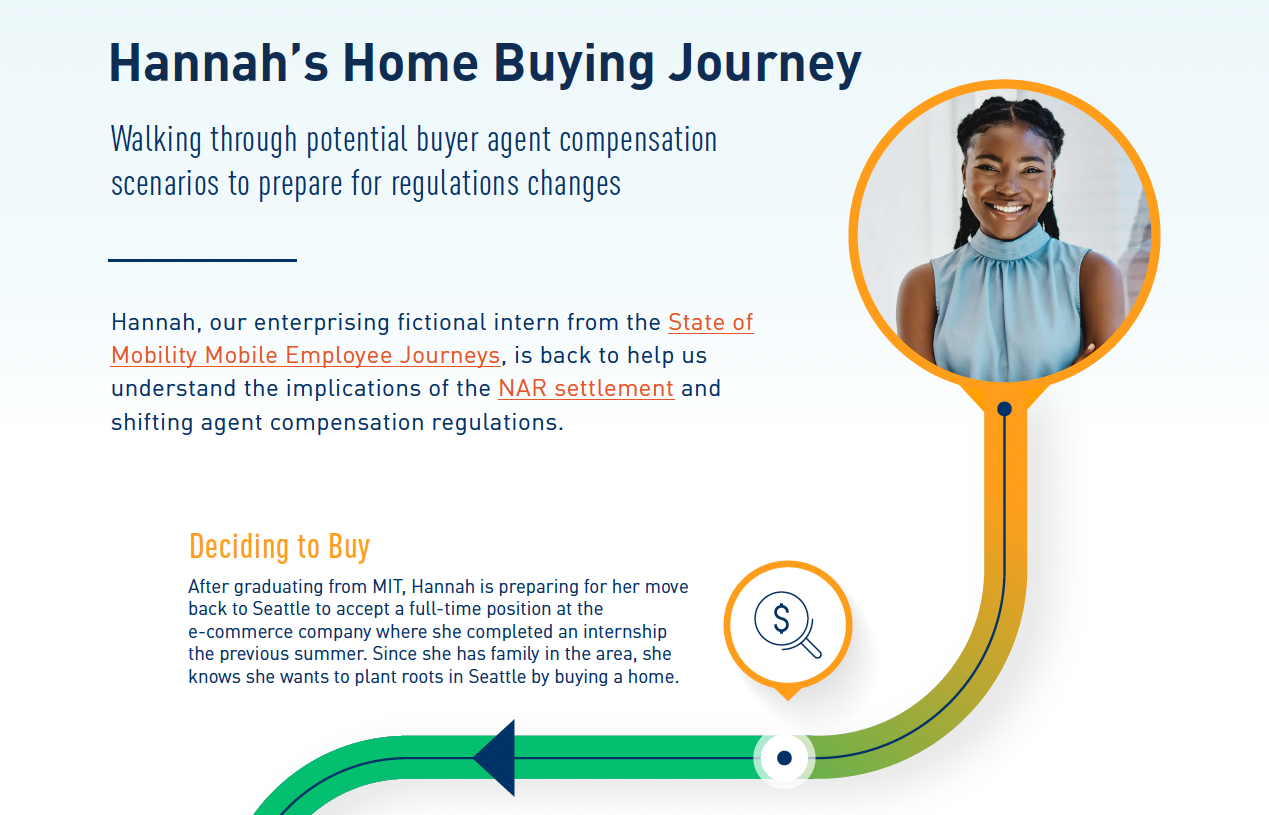
Hannah, our enterprising fictional intern from the State of Mobility Mobile Employee Journeys, is back to help us understand the implications of the NAR settlement and shifting agent compensation regulations. View the full infographic journey.
Graebel has been working closely with clients to assess their mobility programs and tailor possible solutions for them and their mobile employees. Many clients are focused on finding solutions that will still deliver exceptional experiences, understanding that is the key to a successful relocation.
While addressing changing real estate agent compensation models will be an ongoing process, there are a few scenarios mobility managers should explore to ensure mobile employees still have a positive home purchase or sale experience, and mobility program budgets remain in check.
As today’s mobile employees move through the home purchase experience, many are likely to ask their companies about buyer broker compensation benefits, to help offset potentially increased closing costs due to paying their agent’s commission. Graebel is helping clients prepare for these conversations by considering what kind of support they might provide, knowing buyer agent commission benefits could go a long way in helping families accept a relocation.
In partnership with their RMCs, mobility professionals should look at current benefit offerings, possible policy updates and cost implications. Companies may arrive at different solutions, based on their unique situations and mobile employee needs. What’s more, their solution today may change in the future, as the industry better understands the implications of the settlement changes. Mobility professionals will need to be flexible – and should plan to reevaluate options once there’s more information available to make data-driven decisions.
Given the financial and tax implications, here are a few questions to analyze with RMC partners:
Regardless of whether companies offer agent commissions, real estate agents and mobility professionals should encourage buyers to not limit their searches based on their benefits. While some sellers may initially say they won’t cover buyer agent commissions, the entire home buying process is a negotiation that takes place over time – including discussions about buyer agent commissions. The sellers’ circumstances or mindsets may change, and they may be willing to reconsider paying agent commissions; it’s always worth asking, to not miss out on a dream home.
In conversations with clients, Graebel continues to hear concerns about the impacts of the settlement changes on the employee experience. Creating a positive relocation experience should remain a priority for mobility professionals, who should consider the following scenarios as they navigate the evolving real estate landscape.
With real estate professionals facing the possibility of reduced compensation to represent buyers, industry experts are speculating that many agents may leave the business, while more established agents may elect to limit their representation to sellers only. This consolidation would leave mobile employees without the expertise or support needed to purchase a home, especially for first-time buyers.
Mobility professionals and mobile employees should be able to rely on their RMC partners to facilitate introductions to trusted, vetted supplier partners, including real estate professionals. Here are a few questions to ask RMC partners as they navigate potential consolidation in the industry:
It won’t be automatically assumed that sellers will pay both seller and agent commissions moving forward – but that doesn’t mean that they shouldn’t consider doing so. Mobile employees will still need to sell their homes, and not offering buyer agent compensation could hinder that ability. Just as mobility professionals are working with RMCs to evaluate possible solutions to buyer agent compensation, they should consider benefits for sellers too.

Follow the journey of Selena, a fictional employee created to help mobility professionals understand the implications of the NAR settlement and shifting agent compensation regulations – this time from the seller’s perspective. View the full infographic journey.